

It’s now been two and-a-half years since Dieffenbacher acquired the know-how and key assets of Bertsch Energy in a strategic move to expand its energy systems portfolio.
The move increased Dieffenbacher’s energy systems portfolio to include fluidised bed combustion technology for solid fuels (such as biomass, RDF and rejects), gas- and liquid-fuel-fired power plants, heat recovery steam generators, and industrial waste heat systems. The acquisition further extended Dieffenbacher’s existing long-time offering of conventional grate firing in energy systems and resulted in the formation of Dieffenbacher Energy. With this move, Dieffenbacher expanded its portfolio to include a fourth business unit, Energy, alongside its three existing business units, Wood, Recycling, and Forming.
Now, the Energy business unit reports a stepwise increasing contribution to Dieffenbacher Group turnover, the construction of a new office in Bludenz, and plans to expand its service offering internationally.
“We had a good start on the newly founded company – Dieffenbacher Energy – in 2023,” said Wolfgang Lashofer, managing director of Dieffenbacher Energy.
“The business started developing quite well and its turnover in 2024 was 10% of the Dieffenbacher Group turnover. This year it will be about 20% of the Group turnover. We will stepwise grow and increase our contribution to the group further, so I think it is running quite well.”
Dieffenbacher Group clearly sees great potential in the business and has committed to building a new central office for the unit in Bludenz, Austria.
All planning permissions have been secured, and construction work will begin on the new office building this autumn. It will be located near the company’s two existing sites, in walking distance of the Bludenz train station and the old town.
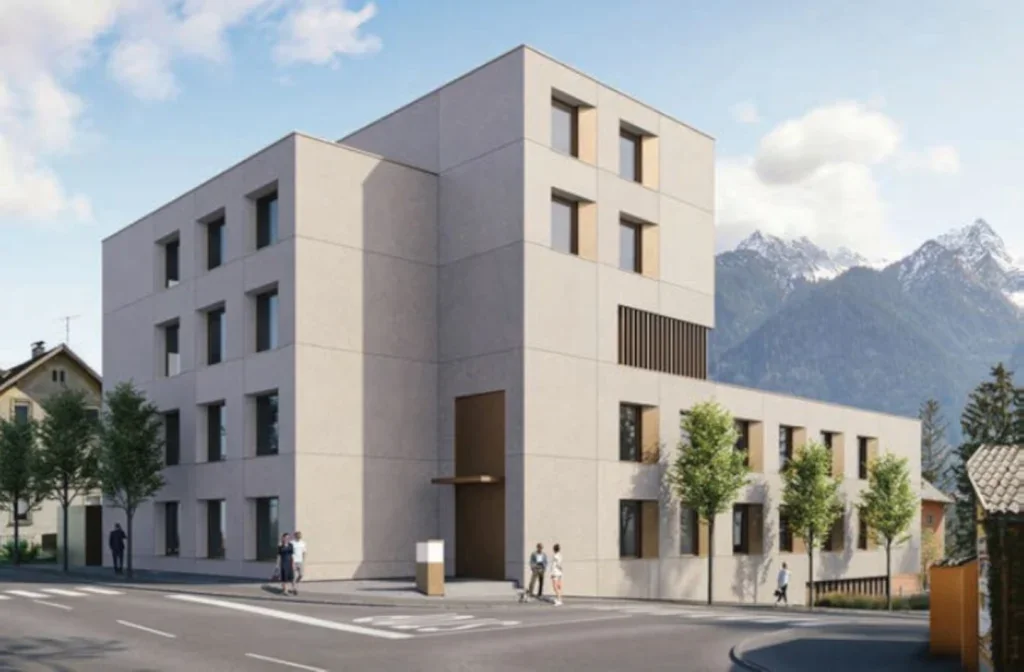
Featuring a large roof terrace, it will accommodate more than 140 workstations in more than 1,400m² of office space. In the meantime, Dieffenbacher Energy continues to rent the existing site until the new building is complete in 2027.
“It enables us to provide our employees – currently just over 100 here in Bludenz – with state-of-the-art workplaces and create an atmosphere that supports them in their daily work. The new building also offers us sufficient space for further personnel growth,” explained Mr Lashofer.
“I think it’s even more important that we will be able to bring our team, which has been working at two different locations in Bludenz, together in one place.
“This will strengthen our sense of unity, facilitate internal co-ordination and accelerate our processes. Ultimately, this benefits our partners and customers in the form of improved workflows, shorter response times and even more intensive support.”
GROWING GLOBAL PRESENCE
While the development is a big commitment in Europe, Mr Lashofer says there is also an equal commitment to growing the business’s international footprint, to provide an enhanced local presence on markets, starting with the service organisation.
“In the past Bertsch Energy had no specific focus on service, therefore our target is to grow this more. We are hiring people globally because service is always a local organisation to support our customers better, and with a strong service organisation we can also support and increase our activities for capital business.”
Currently, Dieffenbacher Energy’s business is mainly focused on Europe, but a big order from Weyerhaeuser in the US last year showcased its global reach.
The forest products manufacturer produces lumber, engineered wood products, OSB, plywood and MDF. Weyerhaeuser was a previous customer of Dieffenbacher in supplying wood-based panels production technology, but not for energy systems and Bertsch Energy had not been active in North America.
Weyerhaeuser’s US$500m investment is for a new TimberStrand (laminated strand lumber – LSL) facility near Monticello and Warren, Arkansas, effectively doubling its LSL capacity. The facility will have an annual production capacity of approximately 10 million ft3 (283,000m3), which is comparable to the company’s existing TimberStrand facility in Kenora, Ontario. Completion is planned for 2027.
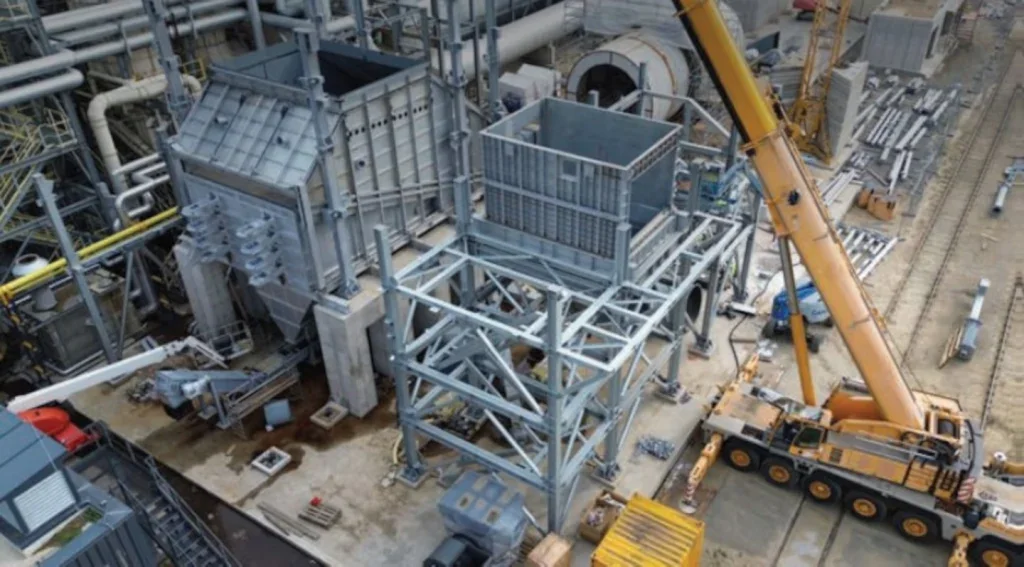
Dieffenbacher Energy’s order includes a biomass-fuelled co-generation system with turbine. The power plant will produce steam to heat the thermal oil for the press, and a steam turbine will generate electricity to supply 100% of the plant’s electrical needs.
Dieffenbacher in Eppingen is supplying the press and forming lines for the plant.
“Together with the existing and well established Dieffenbacher organisation in North America, we will provide the servicing and support the customer over the whole lifecycle of the plant,” added Mr Lashofer.
The existing Dieffenbacher global organisation will be very useful for the energy business’s expansion plans elsewhere, servicing existing Dieffenbacher power plants and also former Bertsch Energy customers.
“There is the possibility to also service other installations, which we’re currently evaluating. But we are already quite busy now with installed capacities of former Bertsch Energy and Dieffenbacher plants. We need to grow in line with our capacities.”
The business unit is reporting some interesting orders in Europe and Asia for servicing, as well as for capital investment projects.
Fletcher Building Ltd of New Zealand ordered an energy plant for its new OSB mill project in Taupo, which will replace an older particleboard line. Start-up is scheduled for spring 2026 and Dieffenbacher Energy has delivered a biomass-fuelled power plant based on grate firing technology (30 MWt) in order to provide the energy for the OSB / Fine OSB production process.
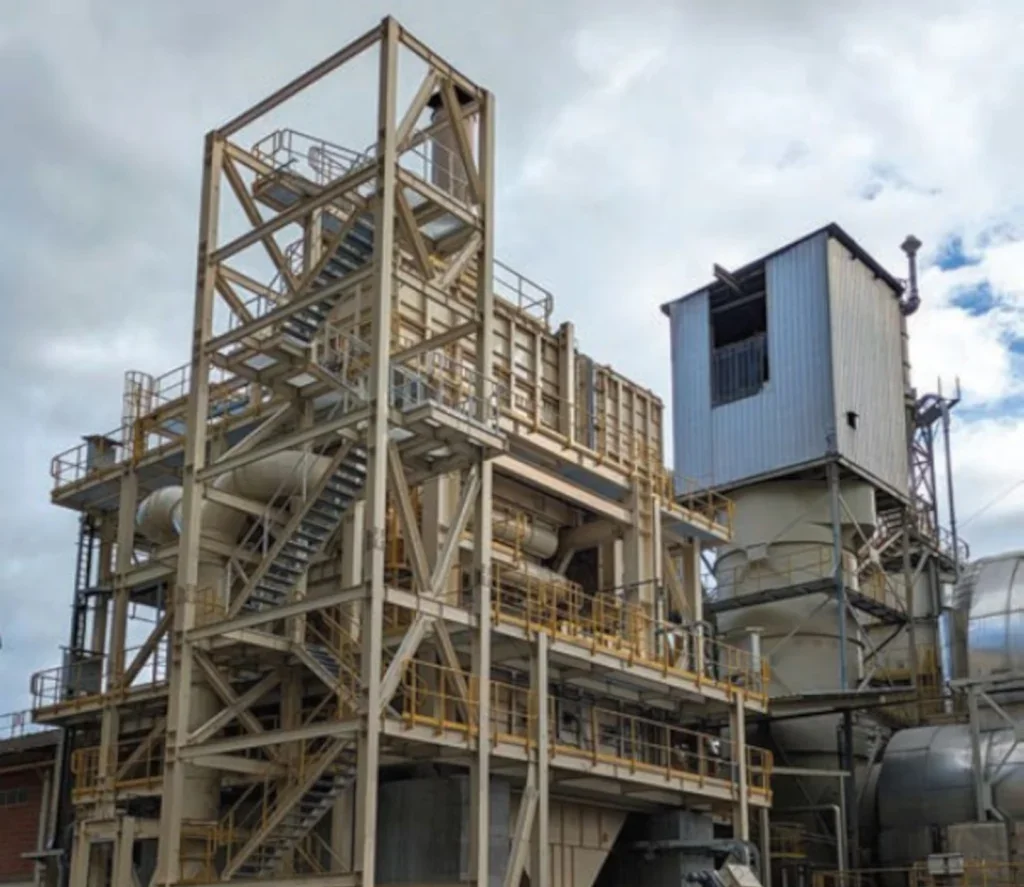
Another project is Lignatherm, the new wood fibre insulation plant project for Schilliger Holz near Küssnacht am Rigi, Switzerland. A wood-fired grate heating plant is currently being erected, with the entire factory project scheduled for commissioning in 2026.
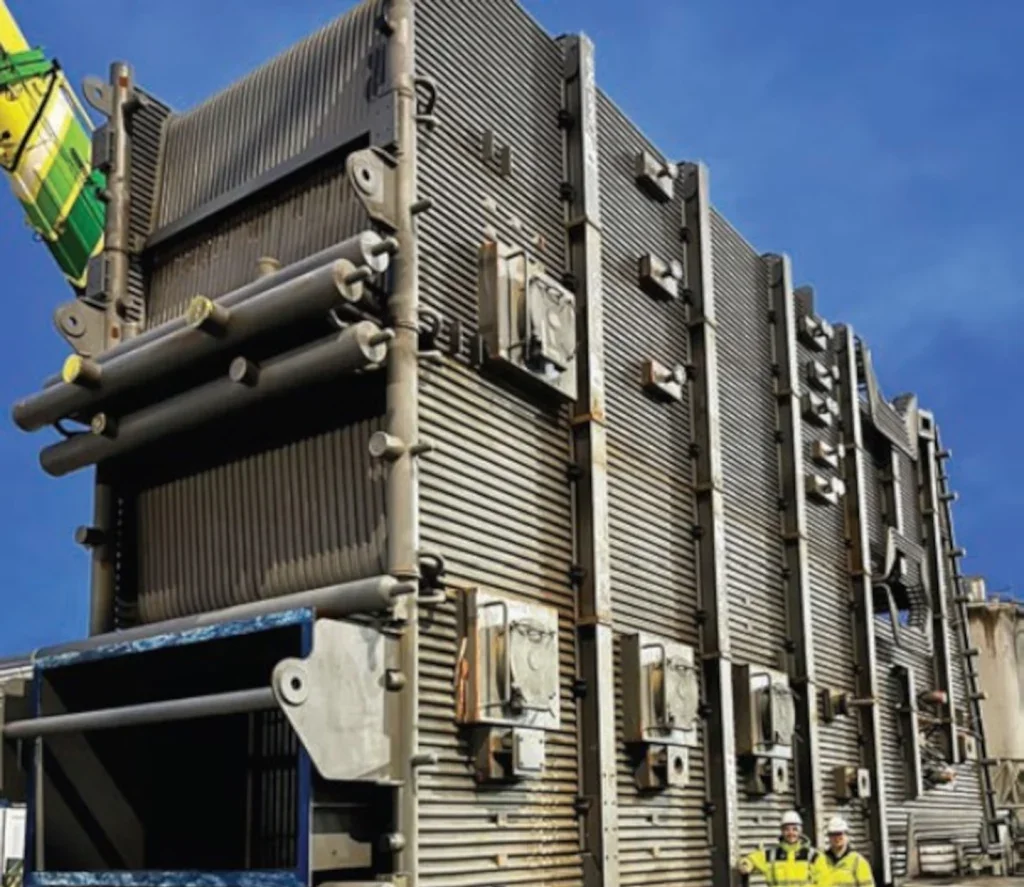
The 82-ton water pipe boiler was delivered in four prefabricated components and then assembled into a single component on the construction site. The boiler is 9m long, 4.5m wide and 17m high, with 11,000m of pipes inside.
The company also installed an energy system at Swiss Krono in Europe at the end of 2024 – the 58 MW biomass furnace with grate technology supplies thermal oil consumers with hot thermal oil (approx 21 MW) and a Dieffenbacher dryer with hot gas (approx 34 MW). Another feature is a shot cleaning system for cleaning the thermal oil registers.
In South America, a 30MW energy plant that uses reciprocating grate technology to combust waste wood has been supplied to Novopan in Quito, Ecuador. The order also included a Maier Big Crusher and Maier Rechipper to process waste wood and eucalyptus bark.
“This new energy plant moves us away from burning oil and toward biomass, further accelerating our sustainability efforts,” said Ignacio Bustamante, CEO of Novopan del Ecuador after the contract signing in 2024.
“We were impressed by Dieffenbacher’s expertise in combining the drum dryer and hot gas generator and their grate design tailored to waste wood,” he added.
The project included connecting the new energy plant to an existing vertical combustion chamber, replacing the heavy oil burner.
Dieffenbacher has a strong relationship with Novopan, its most significant achievement being the installation and commissioning of the company’s second continuous particleboard line in 2019.
In Egypt, a new MDF plant for the National Service Projects Organisation (NSPO) is also utilising a Dieffenbacher Energy plant. The contract included a 29MW energy system consisting of a solid fuel fired steam boiler and a thermal oil heater.
This represented the first time the Dieffenbacher Group had integrated a Dieffenbacher Energy solution into one of its Wood business unit projects, with the Austrian and German energy experts from Bludenz and Eppingen working closely together to provide NSPO with a customised solution to the special requirements of burning palm waste.
Date palm fronds are the locally available raw material for board production.
The collaboration also involved German sub-contractor WESER Industrie- und Anlagentechnik GmbH. The facility is being built in the Toshka region and is scheduled to produce its first board in the autumn of 2025, with around 125,000m³ of MDF/HDF output per year.
ENERGY SYSTEMS MARKET DYNAMICS
This year Dieffenbacher Energy plans to generate €80-€100m turnover, with the majority of this in large systems outside the wood-based panels industries. In fact, the share of orders from the panels industry will be small in 2025. This is because projects take two to three years to realise and 2023 was a year when most orders were booked outside of the sector.
“It is always changing, but the majority of the business in 2024 was in the wood-based panels industry and now this year it looks like the majority is again outside the panels industry, impacted by the economic situation and the low investments in the panel industry this year,” said Mr Lashofer.
Next year will probably reveal more projects being implemented in the panels sector. But Mr Lashofer pointed out that wood-based panel sector investments were generally slowing down, with customers often waiting or postponing projects.
In the larger power plant business, the provision of grants to replace gas or coal with biomass-fuelled systems is an important prerequisite, as is the current price of energy. Grants provision has slowed in some European countries, and the level of grant varies between countries.
“Energy demand is growing by 2-3% a year annually and there are governments and countries with targets to reduce CO2 emissions with new energy programmes, mainly in central Europe,” added Mr Lashofer.
“Some other countries are not so focused on that; they are more focused on energy costs but not on a reduction of CO2 emissions and fossil fuels.
“The wood-based panels industry already has an advantage, as they already have access to wood, bark, or sawdust. This existing supply chain could be used to supply biomass as fuel not only to produce energy for their own production.
“Panel producers have already started to invest in their own big power plants to also supply electrical energy to the grid and heat to central heating systems. These synergies make very much sense and generate additional opportunities for the panel industry.
“Board producers typically need to heat thermal oil for press operations, flue gas for the dryer, and in the cases of MDF lines, additional steam for operating the refiner. There is only one further step necessary to start operating a power plant with a steam turbine supplying electrical energy to the plant or to the grid.
“From 20MW up to 120MW, this is our current range for biomass fired power plants,” explained Mr Lashofer. “We can offer grate technology for solid fuel in the 20-80MW range. For small capacity, the grate technology has some advantages, mainly based on costs. If there is larger capacity and the energy demand is bigger, then the fluidised bed technology has significant advantages.
“There are a lot of possibilities to use biomass, firstly in the wood-based panels, furniture and building industries. The trends are to use the wood raw material first for making the product, then use the waste wood – sorting it, and the usable material producing particleboard and the unusable for energy production purposes. That is an excellent example for a sustainable circular economy.”
Of course, there are wider questions about sourcing wood waste, collecting it and transporting material, as well as the price, for its widescale adoption. Supply tends to grow when economic development is strong, with more people buying new furniture and recycling old furniture.
Dieffenbacher Energy sees upcoming opportunities for biomass energy in countries which do not currently have high levels of sustainable energy, such as in South America, Africa and Asia.
“There is the opportunity to convert energy production based on gas or oil to sustainable energy, but it certainly always depends on the actual costs and the local circumstances.
“I am really concerned that energy prices in Europe will further increase. This concerns me as this would have a very negative impact on development in the industry. If electrical energy is more expensive, then the big industries will further transfer production units outside Europe to low-energy-cost countries. We see this already.”
Mr Lashofer noted a move in Germany towards replacing coal-fired power stations with gas-fired facilities, with a clear plan and target to use hydrogen as a potential replacement for gas in 10-15 years. Coalfired community central heating systems in cities are also seeing a switch over to biomass boilers or gas power.
Solar and wind power have proved a popular form of renewable energy, with some wood-based panel producers utilising solar panels on warehouse roofs. However, depending on the region, the contribution to actual demand may be small and insufficient for continuous production, meaning that efficient power plants will continue to be needed for the manufacture of wood-based panels in the future.
“Global energy demand is growing, and investment decisions in the industry are very heavily depending on the price of energy and on how to secure the supply of green and sustainable energy in the future,” Mr Lashofer concluded. “In Europe we have to ensure energy prices are competitive to support the industry.”


