

A visit to the UNESCO World Heritage site of Fagus-GreCon in Alfeld – famed for its industrial architectural heritage as well as the products manufactured there – is always valuable when it’s important to assess latest developments in measuring systems and fire protection technology.
These technical solutions are critically important in global wood-based panels manufacturing and a steady stream of innovations have been launched by Fagus- GreCon in 2025.
Since our last visit, the company has undergone a management changes (in 2024), which saw Alexander Kuppe and Mario Haas assume joint managing director roles, with a focus on strategic expansion, further internationalisation and strengthening of other application areas.
The company also celebrated its milestone 50th anniversary in 2024. The long established shoe lasts business at Alfeld was also sold to the unit’s management and has relocated to another building on the site, allowing the company to focus solely on its core operating areas.
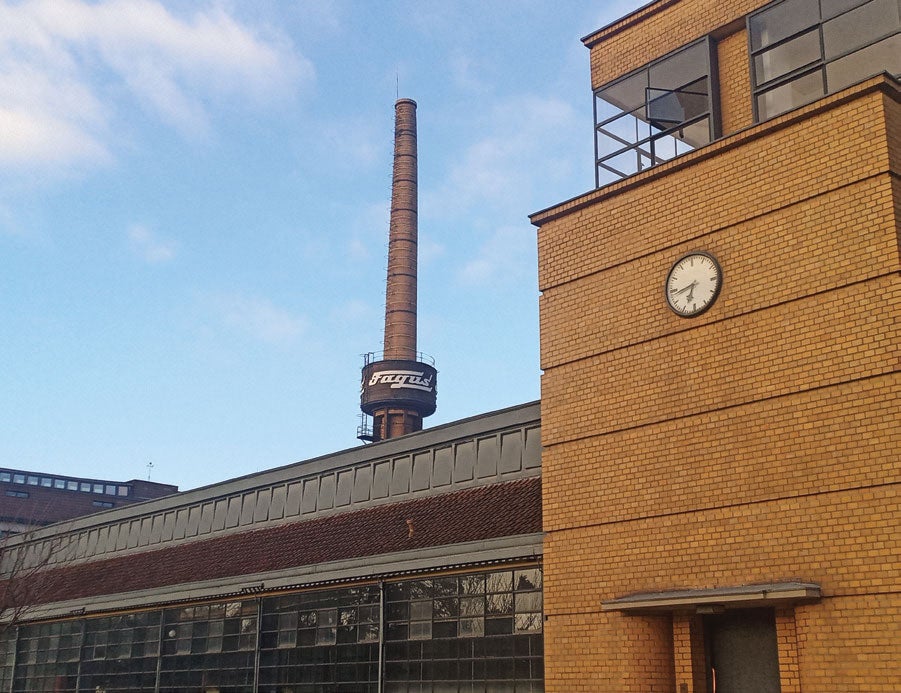
When I caught up with Mr Kuppe and Mr Haas in the hallowed halls of the Fagus building, designed by architects Walter Gropius and Adolf Meyer in 1911, both men conveyed a strong focus of looking to the future, growing the business and being a solutions-oriented company that provided customised solutions, not supplying products “shipped in a box”.
Mr Haas explained that preceding WBPI’s visit had been the company Annual Meeting, with fourth generation owners Ernst and Gerd Greten discussing future plans with the management. With the fifth generation already involved – the Gretens’ four daughters – and many six generations family members following, the emphasis here is on long-term stability and a pioneering spirit, he added.
Mr Kuppe summarised some recent developments.
“The shareholders of the business want to have a much higher internationalisation of the business than previously,” he said. “The other aspect is keeping a very strong position in the wood-based panels industry but also conquering other markets – partly for growth reasons but also not to be too dependent on one sector.”
There is also a different model for the two operating units.
“In the last two years we have merged the market approach with the two of them more or less operating together, so we do not have people specifically selling products, but instead focus on certain industries. We are trying to look through the eyes of the customer, who wants to see one face for all their needs.”
The focus on internationalisation allows the company to more easily handle multi-national customers with a relatively small team.
“We have nice examples in industries outside of wood-based panels, such as recycling, where 2 or 3 people are covering a certain industry or region, compared to 5 or 6 people working on different products and certain customers.”
The approach emphasises the solutions based approach and is part of Fagus-GreCon’s strategic vision document, depicted in a graphic shaped like the Alfeld factory building.
The roof represents vision; three central pillars symbolize innovation, customer focus and digitalisation, while the foundation contains the core values of a pioneering spirit, responsibility and a people-centric culture.
On the last point, founder Carl Benscheidt puts it well: “Our wealth is not our machines, nor a bank account, but the knowledge, skills and dedication of our employees.”
Approximately 80% of the Fagus- GreCon measuring systems are used in the construction sector (including wood-based panels, gypsum, and insulation materials).
On the fire protection side, many different industries are now being targeted, with the traditional construction sector still comprising 50% of business.
MARKET ASSESSMENT
The wood-based panels sector, Fagus-GreCon’s largest market area, has obviously been challenging during the past two years, with less new line work, but modernisations continue.
“2025 has been a reasonable year,” summarised Mr Kuppe.
“We have not achieved our growth targets mainly because we have not seen the investment levels in the wood-based panels industry. Markets outside this sector have fully met the growth targets, and in some cases even overperformed. Overall, we have managed the situation quite well and we think we are in a very good position for 2026.
We also believe investment cycles in the wood-based panels sector will come back.”
He said while investment was happening in China, there was overcapacity and consolidation was to be expected. China ranks as the second largest of Fagus- GreCon’s seven global subsidiaries and celebrated its 20th anniversary in 2025, but reduced level of market activity has been seen there this year.
“We had a demanding year in North America this year for various reasons.
We can manage the tariffs quite well. It has an impact on prices, but it’s more the uncertainty created on the customer side which meant they held back on investments.
“Latin America looked like it was going to be a demanding year but actually has been quite good. We have seen they have been doing business as usual. We still have a couple of projects in execution in SE Asia, with some more projects announced, but it is probably slowing down next year.
“We have quite a number of orders this year already in India and expect more in the coming years. Several delays have been requested by customers or OEMs, mostly in the panels sector. The recycling industry is different; they want the technology immediately.”
There have been some good activities in niche wood-based panels markets in Europe, with business there at a stable lower level.
Fagus-GreCon has strived to become more efficient during this period, optimising internal processes and localising several products and solutions.
Recycling a major trend and in 2025 was the second largest industry area for the company. Mr Haas pointed out that mega trends like MDF recycling was also a big topic, with Fagus-GreCon particle detection technology able to bring quality control to the recycling process, highlighting foreign materials in the material flows. “We have the high-end equipment to guide this process,” he said.
TECHNOLOGY INNOVATIONS
The LIGNA exhibition in 2025 saw a number of innovations on the Fagus-GreCon stand. Digitalisation was a major focus.
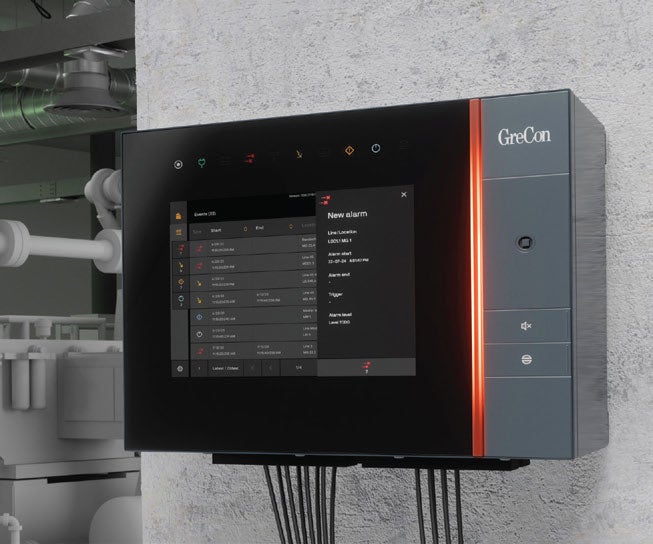
Mission Control, the next generation of intelligent spark detection control panels, was a major feature. This innovative system combines predictive maintenance, plug-&- play integration, and comprehensive remote access — minimising downtime, enhancing safety, and maximising efficiency.
The decentralised system offers smart networking, real-time monitoring, and maximum system reliability.
With its Segmented Maintenance Technology (SMT), GreCon Mission Control allows for scheduled and unscheduled maintenance to be carried out on individual components or segments of the production line without shutting down the entire system.
The interface has a traffic light system for displaying warnings. Key functions are accessible in just a few clicks, and the system significantly reduces installation complexity, while increasing safety for the customer.
It generated a lot of interest at LIGNA, and the first systems are being rolled out in Europe.
Other LIGNA highlights were updates in the GASANALYSER range – GASANALYSER SL measures formaldehyde emissions in accordance with ISO 12460-3:2023 (perforator method) and CARB specifications.
The laboratory solution uses laser spectroscopy instead of traditional wet chemistry in a fully automated measurement process, the GASANALYSER SL delivers complete test results in just 4 hours – without chemical post-processing and without additional personnel.
Meanwhile, the GASANALYSER MC delivers accurate results in just 15 minutes, enabling faster and more precise control of production processes, thanks to the combination of a microchamber and state-of-the- art infrared laser spectroscopy.
GreCon systems are also available for inline formaldehyde measurement.
Another innovation is PARTICLEVIEW 2D, an inline camera-based measuring system which measures two dimensions in the forming line, to check board strength, glue consumption, and surface quality.
PARTICLEVIEW provides the data needed to control chip geometry continuously, detecting deviations at an early stage and optimising glue consumption and board quality.
The company’s FORMATOR – which automatically measures and regulates material distribution in the mat – has now been extended for particleboard production after many years of success in the MDF industry.
Mr Kuppe reported a fast return on investment on GreCon technology, saying FIBERVIEW (for MDF) measuring technology payback is as little as 4-6 months. Customers can provide GreCon with their production data to simulate the product before purchase – giving them confidence of the benefits and payback.
FUTURE
So, how does Fagus-GreCon see the next couple of years?
“We would think the economy would be better, the construction industry back to investment mode.,” said Mr Kuppe.
“We are also looking at growing market shares. We have high market share in the wood-based panels sector, and our goal is to maintain that and grow in regions which are seeing increased investment.”
“We have an ambitious target to achieve a good two-digit growth level every year.
“There is a weakness in the wood-based panels market and there have been a lot of sidesteps in the market. We are prepared for a difficult 2026 and if the second half of 2026 shows an upward trend we would be quite happy.”
Even if there is less new line work, modernisation contracts continue, and new market sectors are being actively targeted, with the recycling industry being a big growth market. A continual focus on R&D, internationalisation, integrated solutions, customer service, and digitalisation means the company is positioning itself well for the future.


