

Momentum is building to produce ever greener wood boards.
While already having good sustainability credentials compared to many alternative materials, the move to reach ever higher standards in the composition and performance of boards continues.
A new Horizon Europe project, SUSBOARD, launched in 2025 with an aim to transform the wood panel and furniture industries. It will develop a 100% biobased, formaldehydefree and cost-competitive adhesive for particleboard (PB) and medium-density fibreboard (MDF).
Every year, Europe produces around 60 million m³ of PB and MDF, both of which are essential materials for construction and furniture manufacturing. Today, these boards largely rely on fossil-based adhesives that emit formaldehyde and contribute to carbon emissions.
While the environmental performance of the boards is still considered generally good, SUSBOARD has joined the trend of developing new boards to target higher standards.
With a budget of €9.1m, SUSBOARD aims to deliver an innovative alternative that will ultimately support Europe’s path to climate neutrality.
“SUSBOARD is a strong example of how science and industry can work hand in hand to deliver tangible solutions for Europe’s Green Deal Industrial Plan,” said RTDS Association, the SUSBOARD project coordinator.
Building on the success of the SUSBIND project, which achieved more than 80% renewable raw materials in adhesives, SUSBOARD will complete the transition by introducing a fully bio-based amine component.
This breakthrough is expected to reduce the carbon footprint of wood boards by up to 30% while eliminating formaldehyde-related health risks for consumers and workers.
“Our project will demonstrate that 100% bio-based adhesives can deliver competitive performance and cost efficiency while supporting Europe’s climate objectives,” added Wood K plus, the project’s scientific co-ordinator.
The project aligns closely with the European Green Deal, Circular Economy Action Plan, and Zero Pollution Action Plan, supporting Europe’s shift towards a fossil-free and greener future. By cutting industrial carbon emissions, reducing volatile organic compound (VOC) emissions, and fully eliminating formaldehyde-related health risks, SUSBOARD aims to contribute to healthier indoor environments and safer working conditions.
Over the next four years, the project will:
- Scale production of the new adhesive to multi-ton levels, demonstrate performance on industrial production lines
- Test applications in furniture manufacturing
- Develop a prototype modular furniture product
- Ensure sustainability through a full Safe and Sustainable by Design assessment
The project unites leading research institutes, global chemical companies, and major wood panel producers from Austria, Germany, Portugal, and Turkey, including: RTDS Association, Wood K plus, IHD Dresden, Cargill, BASF SE, Sonae Arauco, Kastamonu Entegre, Balorman INT, and Saréco.
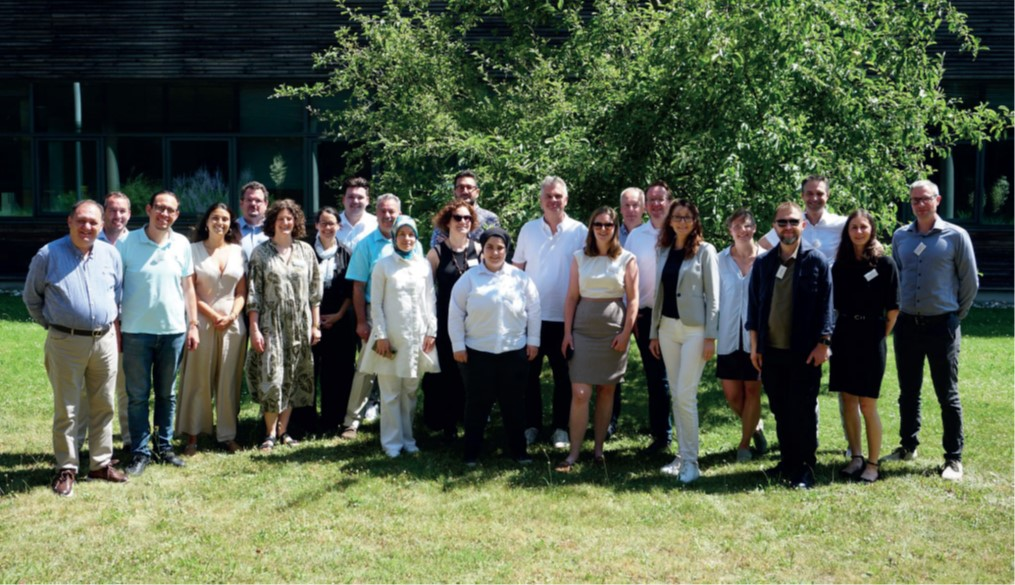
The official three-day launch was held in Tulln, Austria, in June 2025, hosted by Wood K plus – Kompetenzzentrum Holz GmbH.
The event brought together 7 EU and 2 non-EU partners, combining expertise in biotechnology, materials science, industrial manufacturing, and sustainability.
The collaboration was described as “incredibly fruitful” – with productive discussions, alignment on key goals, and a shared commitment to drive innovation in the wood board industry.
“We’re proud to be working together to replace fossil-based components with sustainable solutions, reduce formaldehyde emissions, and support the EU’s bioeconomy and climate objectives,” the project boldly stated.
Kastamonu Entegre is one of the international board producers involved in the project, with it playing a key role in moving sustainable solutions from the lab to the living room.
The company’s ultimate role in SUSBOARD is to help facilitate industrial-scale production – taking the developed bio-based adhesives and implementing them into largescale MDF manufacturing.
It also plans to help real-world testing by validating the performance, durability, and safety of the eco-friendly panels under actual production conditions.
And, of course by keeping the Circular Economy in mind, but ensuring that sustainability doesn’t come at the cost of industrial efficiency.
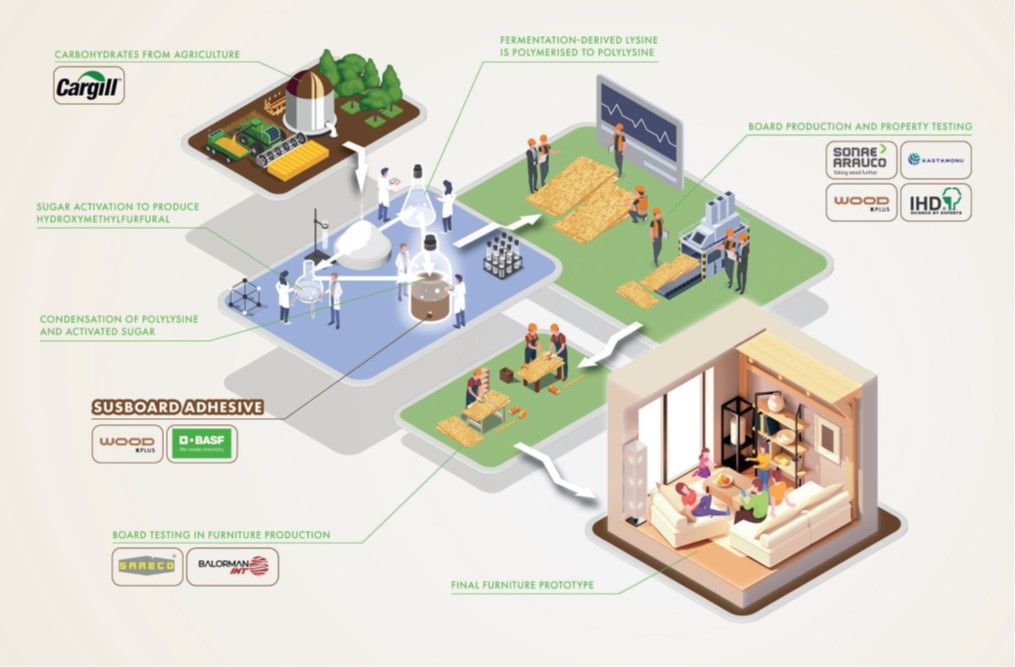
Sonae Arauco’s involvement in SUSBOARD is also a key enabler of the company’s decarbonization strategy. Adhesives and chemicals represent a significant share of its Scope 3 emissions, which account for approximately 82% of its total GHG footprint. By supporting the development of bio-based adhesives, it says it is actively searching for solutions to reduce emissions across its value chain.
Project partner Cargill, a multi-national food and agricultural solutions supplier, is leading the development of the bio-based feedstock that forms the foundation of the new binder system. This contribution builds on its deep expertise in bioindustrial processes — ensuring high performance and process efficiency for the innovative adhesives being developed.
Another project partner is SARÉCO, a specialist in decorative panels for interior design, retail, and furniture. Its aim in participating is to provide a real-world production environment to test the 100% biobased adhesive systems. Their expertise is expected to be valuable in ensuring SUSBOARD sustainable innovations are finding their way to everyday use.
PROJECT PROGRESS
As the project moved into 2026, laboratory press trials for both particleboard and MDF were progressing.
Wood K plus is working on the PB pressing series, conditioning and mechanical testing under controlled lab conditions.
Institut für Holztechnologie Dresden gemeinnützige GmbH (IHD) is conducting MDF press trials, testing and evaluation, with further assessment ongoing.
The next steps will be:
- A new PB press series
- Analysis of adhesive distribution
- First MDF press series using SUSBOARD bio-based adhesives
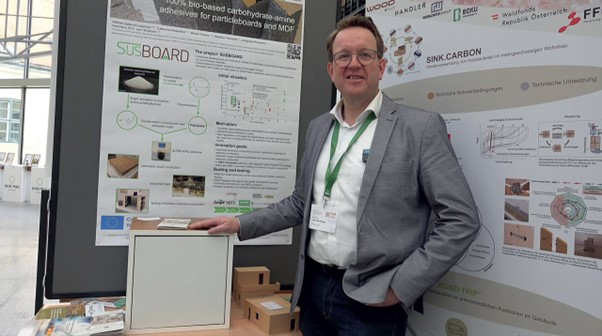
SUSBOARD has also been getting the message out there, with attendance at the COLI Summit 2026 in Vienna that took place in February.
The event brought together policymakers, researchers and industry leaders to focus on issues related to the sustainable forestbased bioeconomy, such as scaling up, financing, supply chains, agroforestry and wood buildings. It aimed to facilitate the exchange of knowledge, good practices, and identification of opportunities and challenges that countries and stakeholders are facing regarding implementing forestbased bioeconomy.
SUSBOARD scientific co-ordinator Erik van Herwijnen of Wood K plus shared on the aims and progress of the project.
“It was a valuable opportunity for us to connect innovation with global policy dialogue and to position SUSBOARD within the future of the forest-based bioeconomy,” he said.
At an earlier event in September 2025, the SUSBOARD project was featured at the 8th International Conference Processing Technologies for the Forest and Bio-based Products Industries (PTF BPI), held at the Salzburg University of Applied Sciences campus in Kuchl.
The event brought together more than 80 experts from 16 countries to discuss the latest developments in wood research, biobased materials, and sustainable production.
The two-day conference served as a vibrant platform for scientific exchange, international collaboration, and professional networking; further strengthening ties within the European research community. Wood K plus participated with two insightful presentations about the SUSBOARD project aims.
In his presentation, Dr Erik van Herwijnen discussed the ongoing work of the SUSBOARD consortium, building on the previous research conducted under the SUSBIND project, which demonstrated the potential of carbohydrate-based adhesives. While SUSBIND achieved significant performance improvements, it still relied partly on fossil-based amines, resulting in a higher-than-desired carbon footprint.
“Our goal is to deliver a sustainable, cost-competitive alternative to conventional ureaformaldehyde resins, without compromising strength, curing speed, or processability,” explained D. van Herwijnen.
The new adhesive concept combines activated carbohydrate syrups with bio-based polylysine, a polymer derived from lysine produced by bacteria (Corynebacterium glutamicum). This approach enables fastcuring, high-strength adhesives suitable for industrial-scale applications.
SUSBOARD aims to reach Technology Readiness Level 7 (TRL 7), validating its technology at a multi-ton pilot scale. This marks a crucial step toward largescale industrial adoption in furniture and construction sectors.
“Sharing our results in an international context allows us to refine our research and gain new ideas for future developments,” noted Dr van Herwijnen.


