

Wemhöner is a name synonymous with the surface finishing industry, with its range of technologies used widely in the furniture and panels sectors.
This year has been a landmark one for the company, passing its 100-year mark, commemorated by a series of events involving customers and employees in Herford, Germany.
WBPI dropped into the factory during our Focus on Germany tour to ask about current developments, projects and its assessment on the market situation.
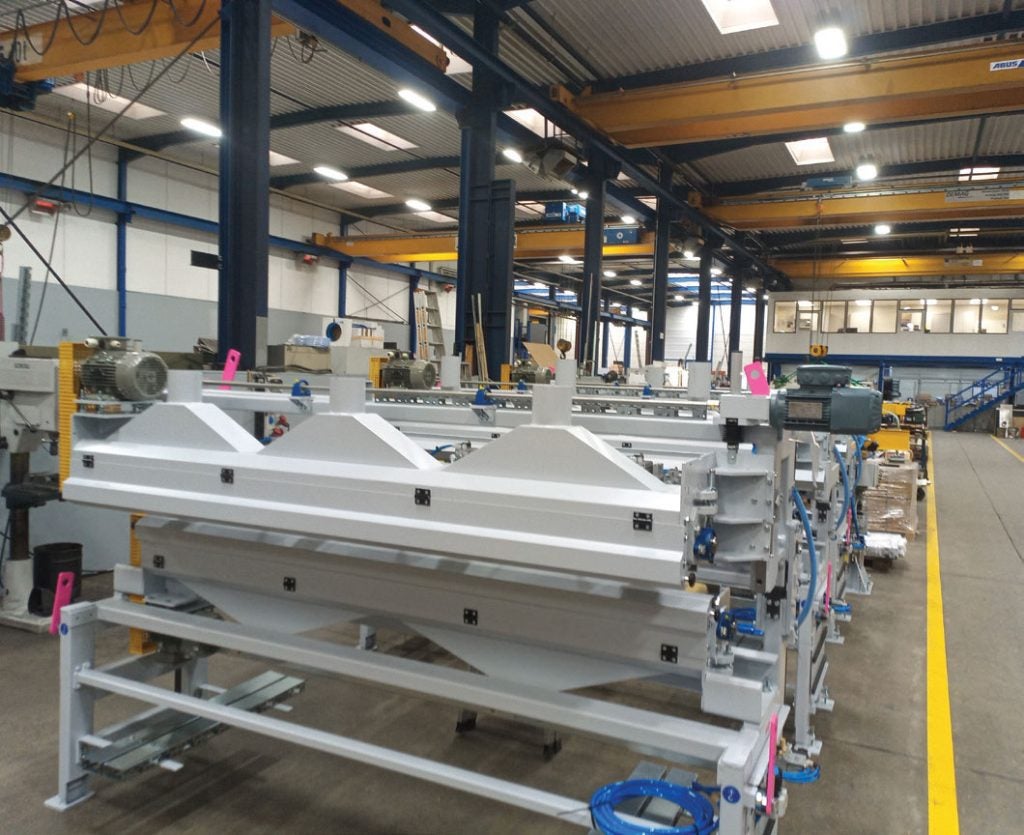
The factory and offices are an impressive sight, with owner Heiner Wemhöner’s equally impressive art collection adorning the halls. Wemhöner’s main facility employees 300 employees and is fully occupied with production until the end of 2026.
The first production hall was established in 1971, and extended in 1972, with further factory hall extensions in 1993 and 2000. There is a dedicated area in the factory where young people are learning skills.
Kathleen Wemhoner, member of the management board and daughter of Mr Wemhöner, said the 100-year anniversary had been a major milestone in the company’s history – with the history commemorated in a special book produced for the occasion.
She said up to 1,300 employees and their families attended the May 1 event – which was also the company founding day.
An extensive array of hospitality and fun characterised the day and among the historic features were elements from the past – an anvil representing the original horseshoe production, plus a display of some of the original tools from the era.
It was not all looking back at the past, there was also an emphasis on looking forward to the future. “There was a really great atmosphere,” said Ms Wemhoner.
The second event later in May was designed to coincide with LIGNA and Interzum, with about 120 attending from countries including Turkey, China, Australia and the US.
Wemhöner is of course well-known for its short-cycle press lines, used widely in the wood-based panels manufacturing and furniture industries, with furniture panels and laminate flooring being key applications. Many manufacturers of particleboard, MDF, plywood, and glued laminated panels have Wemhöner solutions in their production facilities.
Other technologies produced in Herford include 3D presslines for laminating of 3-dimensional with wood-based surfaces combined with the subsequent pressing of thermoplastic foils or veneers designed to provide the ideal foundation for a high level of design freedom in 3D furniture fronts and other applications. The company also produces lacquering lines, calednor lines, troughfeed press lines and press lines for special applications.
MARKET ASSESSMENT
Mr Heiner Wemhöner and Kathleen Wemhöner reflected on the company’s performance in 2025 and shared their opinion on what they see up ahead.
“I think we are in a very strange time in the world in our industry,” said Mr Wemhöner.
“I think we had a fantastic time during Covid. People invested in the furniture industries. But the industry is not in the condition it was two years ago. We are happy we are global and have an export share of 90%. But it is quiet. This doesn’t mean nothing happening, but activity levels are low. A lot of promising projects have been put on the waiting list again.
Ms Wemhöner agreed about the market changes. “We came from crazy times in Covid. It started with uncertainty but then there was such a peak time when people were at home and could not travel, so they started renovating. Our delivery time hit 2.5 years.
“This year has been OK. Compared to 2024 it was a little bit quieter. We see for the next years things start to get a little bit better. There are a lot of discussions. When the people stop talking then something serious is happening. There is still willingness to invest.”
Mr Wemhöner said the factory remained busy, in part due to the decisions to bring certain component production in house – switch cabinets for example are produced at Herford now.
“The good thing is we don’t have to make short working this year. Our customers still believe in us and we are looking at how we can be more efficient, what can we do cheaper, but it is a demanding time. There is business, but if I compare it to 2022 and 2023 it’s completely changed.”
“Customers have told us that they are ready to place the orders but many have postponed them, so it’s difficult to see how the situation will be next year, hopefully we will get some orders and of course we are prepared with our strategy to have more or less turnover.”
Looking at global geographical markets, Ms Wemhöner said countries including India and North Africa, as well as the North America region, were interesting with signs of activity, although Asia and North Africa were very price sensitive about the cost of machinery.
“We see potential in some of those markets, even if Chinese supplieres are offering lower prices,” she said. This was because Chinese machinery makers were extending their reach into other markets with their products.
“For a long time, we did not have much competition in the Chinese market, but Chinese competitors start to compete against us these days.
“The idea of my family to invest in China – now 20 years in the country – was a good idea and if we hadn’t invested then we would have lost the market.”
Mr Wemhöner said he was very happy that the company had invested long term in China, with the operation acting independently from Germany.
The first Chinese factory established in 2005, with production starting in 2007, with three later extensions. By 2018 it had become too small, so another facility was established.
“The situation in China is also different from the years before, as it’s quieter. But the advantage is [our Chinese operation] is very competitive to reach customers we wouldn’t reach from Germany anymore.”
The Chinese company exports products across SE Asia.
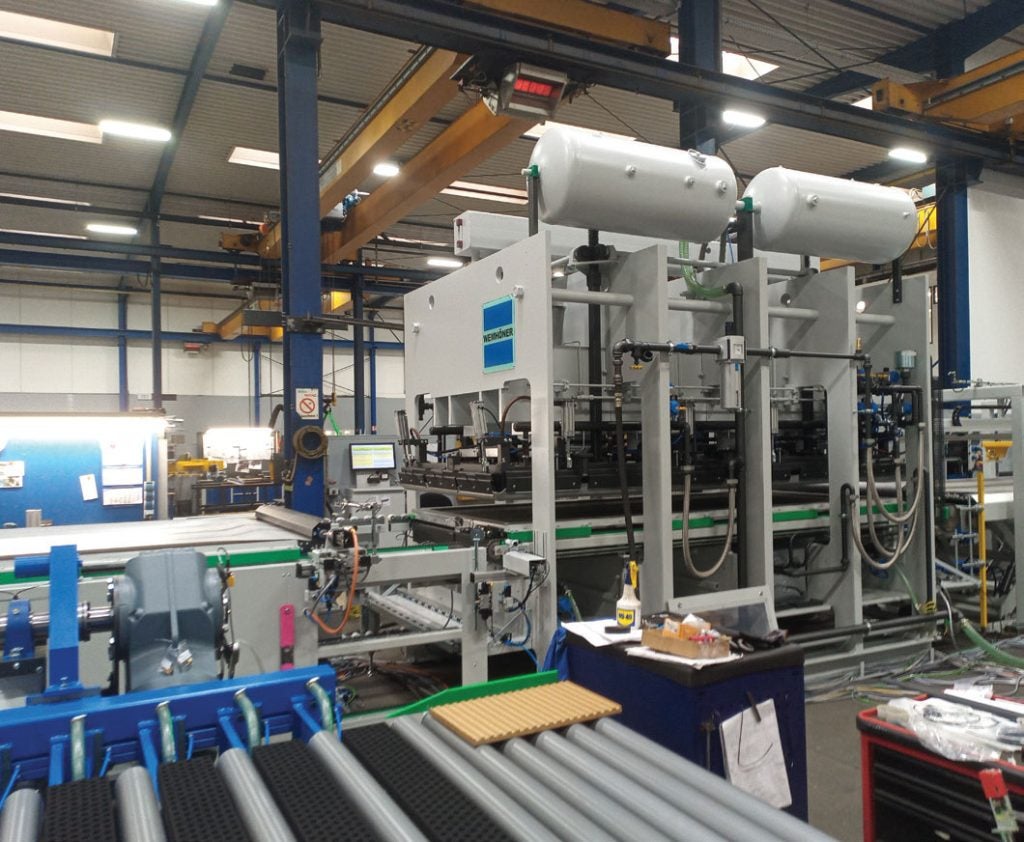
On the project front, several large, short-cycle presses are in the delivery and installation phase, including two lines for Egger at Markt Bibart. The first will be started up by the end of 2025 and the second should be operational by next spring.
“The Egger project is a large investment, it’s nice to have customers that are doing investments in Germany,” said Mr Wemhöner. Meanwhile, a short cycle laminate flooring line will be supplied to Unilin in the US. The machinery is currently being produced and has new features enabling faster and more precise manufacturing.
For Wemhöner, LIGNA proved to be an interesting and important show, with the Master Chamfer a new feature to show customers, while there is a new innovation in the short cycle press as well.
“It was better than expected, as the start of the year was not the busiest,” said Ms Wemhöner.
“I think it was a good fair for us; everyone was really positive afterwards. The numbers are getting more and more international.
Sometimes in the past customers might just go to Interzum. Ideally, both shows can be seen in one week, as people can buy the machinery [at LIGNA) and make the investments decisions are usually not at Interzum the whole week.”
STRATEGY
During WBPI’s visit, Wemhöner took delivery of a book called ‘The secrets of German family businesses”. The company was one of 50 German companies selected for inclusion in the book and represents a special honour.
“It’s a very big compliment to be one of the 50 companies to be selected. You can’t select yourselves,” said Mr Wemhöner. When asked what has been the secret to the company’s enduring success and strong brand, Mr Wemhöner was clear in his response.
“Everything we do is custom designed, nothing is standard. We listen to our customers and give them what they need. We are in close discussion all the time with them, and this is what they like.”
Kathleen Wemhöner echoed the point. “It’s about being close to the client, being creative, having a good team, and with eyes open to what is happening in the world. There are a lot of factors. We have great teams in Germany and China and with our partners around the world.”
Mr Wemhöner has been at the company since 1979, an incredible 46 years. You can see by the way he talks about the company and tours the production lines, that is incredibly proud of the whole operation. But he is looking ahead. “Now my daughter is in the management team and I’m on the way already to slowing down,” he commented.
Ms Wemhöner and chief technology officer Florian Barth, who has been working for the company for 12 years, are gradually taking an increasingly prominent role in the business.


